Followers |ලිපි පල කළ සැණින් දැනුවත් වන්න !

Showing posts with label nutritional state of srilanka. Show all posts

Friday, September 30, 2011

Current Nutritional Status of Chilren in Sri Lanka-II |ශ්‍රී ලංකාවේ ළමා පෝෂණ තත්ත්වය පිලිබඳ විපරමක් -II


please refer the 1st part of this article first


Micronutrient (vitamin and mineral) Deficiencies


Sri Lanka has three major micronutrient deficiencies that have been identified as public health problems, namely, iron, Vitamin A and iodine. The prevalence of anaemia among children under five years, primary schoolchildren, adolescents, adult females and pregnant women are 29.9%, 20.9%, 22.3%, 31.6% and 30.3% respectively. Iodine deficiency has successfully control with the implementation of universal iodination of salt. It was revealed that 29% of children under five years were suffering from Vitamin A deficiency in 2006.


What causes malnutrition?


The common perception stands that the cause for malnutrition is poverty, but in reality it is multifactorial. The immediate causes of malnutrition are inadequate food intake and illnesses; Underlying causes include inadequacies in access to food, inaccessibility to health services, poor sanitary environment, and inadequate caring practices for children, poor eating behaviors and inadequate personal hygiene etc. Complementary feeding is intricately interwoven with various myths, beliefs and practices; many babies receive diluted, unhygienic foods at the incorrect age and in inadequate quantities; inadequate knowledge of complementary food among parents have become a serious issue.


Why does malnutrition matter?


The risks of malnutrition are extremely high during the stages of fetal development and during the first two years of life, it will affect physical growth and mental development and resulting irreversible damages. Experts have shown that eliminating malnutrition would remove one third of the global burden of disease. World Bank has indicated that a 1% increase in height has been associated with a 4% increase in total wages and eliminating anaemia would contribute to an estimated 5-17% increase in lifetime earning. Same time low birth weight has been shown to reduce intelligent quotation (IQ) scores by 5 points.


What are the loopholes in exiting interventions?


Vitamin and mineral supplementation: Free Supplementations of calcium, iron, folate and vitamin ‘C’ which are provided to all pregnant mothers who attend clinics and Vitamin A supplementation for children at 9 months, 18 months and 3 years by the Ministry of Health. Loopholes are poor compliance with vitamins due to lack of appropriate knowledge.


Food supplementation:


The Thriposha food supplementation programme has been in operation since 1976 at the cost of around Rs. 600 million annually. A daily ration of 50 gm is distributed to pregnant mothers throughout pregnancy and lactating mothers for a period of 6 months, and under fives who show growth faltering. Production is inadequate to provide all the needy groups. It suffers from distribution problems, especially in remote areas; the food is shared with families; difficult to maintain regular supplies, daily ration is not enough to cover the minimum requirements;


Nutrition education:


It is mainly implemented at clinics and during home visits by the Public Health personnel. There is hardly any time for nutrition education at many of the largely over-crowded clinics; many mothers travel long distances to the clinic and are impatient to get back to their homes.


Food based dietary guidelines:


Food based dietary guidelines have been developed by the Ministry of Health for Sri Lankans based on customary dietary patterns, taking into account the relevant social, cultural, environmental and agricultural factors affecting food availability, food habits and eating patterns. But the applicability is very low.


Food security interventions:


Since achieving Independence in 1948, Sri Lanka’s Food Security Strategy was determined by three sets of policies


• Achieving self-sufficiency in basic food items such as rice, milk, fish etc.
• A public distribution system through Multi-Purpose Cooperative Societies; and public institutions such as Corporative Wholesale Establishment (CWE), Paddy Marketing Board (PMB) and Food Commissioner’s Dept.
• Welfare Programmes, which included either a food subsidy or food stamps or an income transfer component.


Though the above measures are important to improving food security, the determination of the nutritional status of an individual occurs primarily within a household (family) and is dependent on resource accessibility and availability, intra-household resource distribution and information availability.


Food subsidies and income supplementation programmes: With a view to ensure food security at household level, Sri Lanka has implemented various food subsidy and income supplementation schemes.


• the universal coverage of the food subsidy;
• commodity specific subsidy;
• Food Stamp Scheme;
• the Janasaviya, programme which had micro credit, health and nutrition improvement, infra-structure development, income supplement and entrepreneur development components and lately introduced
• The ongoing Samurdhi programme.
• School breakfast or mid day meal programmes
• Current Mahinda Chinthana programme
Some of these programmes were poor targeting and interrupted flow of distribution, where a substantial proportion of resources were distributed among the non-poor.


Written by-


Dr.Renuka Jayatissa (MBBS,MSc,MD)
Nutrition Specialist and Head, Department of Nutrition, MRI

Wednesday, September 21, 2011

අයඩින් ඌණතාවය තුරන් කරන ලදී! | Iodine deficiency status in Sri Lanka ;Then and Now

 ගලගණ්ඩය බහුල ප්‍රදේශය
1940 දශකයේ පටන්ම ,ලංකාවේ බහුල ගැටළුවක් ලෙස ගලගණ්ඩය හඳුනාගෙන තිබිණි; එසේම තෙත් කලාපයේ බස්නාහිර, සබරගමුව, මධ්‍යම, දකුණු හා ඌව පළාතේ කොටසක්ද ඇතුලත් ගලගණ්ඩය බහුල පටියක් වැනි ප්‍රදේශයක් හඳුනාගනු ලැබිණි.

මෙකල 40% පමණ වූ ගලගණ්ඩ ව්‍යාප්තිය අඩු  කරලීම සඳහා විවිධ ක්‍රියාමාර්ග ගන්නා ලදී.කෙසේ නමුත් 1986 පමණ වන විටද මෙම ප්‍රතිශතය දරුවන් අතර 18% තරම් ඉහල අගයක පැවතුනි.

මෙම තත්වය මර්ධනය කිරීම සඳහා 1990 දී පැවති ලෝක ළමා සමුළුවේ තීරණයන්ටද අනුව වසර 1995 සිට "ලුණු අනිවාර්යයෙන්ම අයඩිනීකෘත කිරීම " ආරම්භ වූ අතර ආහාර පනතට අනුව, ලුණු කර්මාන්තශාලා මට්ටමේදී මිලියනයකට කොටස් 50ක්(50 ppm)අගයයක්ද, පාරිභෝජන/ගෘහස්ථ මට්ටමේදී මිලියනයකට කොටස් 25ක්ද(දැන් මෙය 15ppm ලෙස සලකනු ලැබේ) ලෙස අයඩිනීකෘත කිරීමට  නීති සම්පාදනය විය.

ඉන්පසු විටින් විට 2000,2005, 2010 යන වසර වලදී ලංකාවේ අයඩින් ඌනතා තත්වය සහ අයඩිනීකෘත ලුණු වල තත්ත්වය මැන බැලීම සඳහා වෛද්‍ය පර්යේෂණ ආයතනයේ පෝෂණ අංශය විසින් පසු විපරම් සමීක්ෂණ සිදු කරන ලදී.මෙම සමීෂණ වාර්තා මගින් ශ්‍රී ලාංකික වෛද්‍ය ඉතිහාසයේ තවත් ජය කඩඉමක් සනිටුහන් කරමින් අයඩින් ඌනතාවය දුරලීමේ මට්ටම කරා අප ළඟා වී ඇති බව පෙන්වා දෙනු ලැබීය.

අයඩින් ඌනතාවය තුරන් කරලූ තත්ත්වය යම් රටක් විසින් දිනාගැනීමට නම් ICCIDD නම් සංවිධානය මගින් නියම කර ඇති ප්‍රධාන නිර්ණායක 3 කුත්, අයඩින් ඌනතාවය දුරලීමේ වැඩසටහනට අදාල නිර්ණායක(Programmatic Indicators) 10න් 8 කුත් දිගින් දිගටම සපුරා තිබිය යුතුය.

පහත දැක්වෙන්නේ එම නිර්ණායකයන්ය


criteria for monitoring progress towards sustainable elimination of IDD

Indicators  
Goals
Goiter Prevalence(ගලගණ්ඩ බහුලතාව)
<5%
Urinary Iodine Proportion(මුත්‍රා වල අඩංගු අයඩින් ප්‍රමාණය) below 100μg/L                        
>50%
Proportion(මුත්‍රා වල අඩංගු අයඩින් ප්‍රමාණය)below 50μg/L                                                    
>20%
Salt Iodization Proportion of households using adequately iodized salt(ගෘහාශ්‍රිත ලුණු) 
>90%
Programmatic Indicators
8/10


ශ්‍රී ලංකාව සැලකූ කල වසර 2005 වන විටම මෙම නිර්ණායක සියල්ල සපුරාලමින් අයඩින් ඌණතාවය දුරලීමේ මට්ටම ළඟා කරගත් රටවල් අතලොස්සකින් එකක් බවට පත් වී ඇත.

මෙම සමීක්ෂණ වලදී පාසැල් දරුවන්ගේ හා ගැබිනි මව්වරුන්ගේ ගලගණ්ඩ බහුලතාවය,මුත්‍රා වල අඩංගු අයඩින් ප්‍රමාණය මෙන්ම පානීය ජලයේ අඩංගු අයඩින් ප්‍රමාණයද මැන බලන ලදී.

ගලගණ්ඩ බහුලතාව

මෙය 5%කට අඩුවෙන් තබා ගැනීම අපගේ ඉලක්කය විය යුතුය.2010 දත්ත වලට අනුව දැනට මෙම අගය 4.4% කි(ඉතිහාසයේ අගයයන් සැළකුවහොත් මෙම අගය 1986 – 18.8%,2000 – 18.0% ,2005 – 3.8% පමණ විය). එසේම සෑම පළාතකම පාහේ ගැහැණුන් අතර පිරිමින්ට වඩා ගලගණ්ඩය බහුල බව පෙනී ගොස් ඇත. තවද වයඹ ,මධ්‍යම හා දකුනු පළාත් වල ගලගණ්ඩය උපරිම ලෙස පෙන්නුම් කරන බවද, උතුරු පළාතේ මෙය අවම බවද ඔබට පෙනී යනු ඇත.

ගලගණ්ඩ බහුලතාව 
මුත්‍රා වල අඩංගු අයඩින් ප්‍රමාණය

මෙය වූ කලී අප විසින් ශරීරයට ලබා ගන්නා අයඩින් ප්‍රමාණය පිළිබඳ මිම්මකි. සාමාන්‍ය පුද්ගලයෙකු හට මෙම අගය 100-200 ug/L අතර ප්‍රමාණයක්ද, ගැබිනි මවකට 250ug/L පමණ අගයයක්ද පවත්වාගත යුතු අතර 300ug/Lට වැඩි වීම අයඩින් අධික වීමක් පෙන්නුම් කරයි(මෙහිදී අයඩින් විෂ වීම ඇතිවිය හැකිය ).

 සුදුසු ;එනම් 100-200ug/L අතර අයඩින් ප්‍රමාණයක් මුත්‍රා වල පවතින ළමුන් ප්‍රතිශතය 2000 දී 35.4%, 2005 දී 34.7% හා 2010 දී 37.7% ක් වේ.මේ අනුව ත් අප දරුවන්ගේ අයඩින් ආහාරයට ගැනීමේ සුදුසු පරාසය පවත්වා ගනිමින් සිටින බව පෙනේ.අයඩින් යනු දරුවන්ගේ වැඩීමට හා මොළය වර්ධනයට අත්‍යවශ්‍ය පෝෂකයක් වන බැවින් මෙය ඉතා වැදගත් තත්ත්වයකි.


මුත්‍රා වල අඩංගු අයඩින් ප්‍රමාණය (පාසැල් ළමුන්ගේ)

ගර්භණී මව්වරුන්

කෙසේ වෙතත් 2010 වසරේදී, ගර්භණී මව්වරුන්ගේ මුත්‍රා සාම්පල වල අයඩින් ප්‍රමාණයේ සාමාන්‍ය අගය 113ug/L ලෙස සටහන් විය.වැඩෙන කළළයේ පෝෂණ අවශ්‍යතාවන්ද සපුරාලිය යුතු මෙම කාලයෙදී, මවක් නිසි පරිදි අයඩින් ආහාරයට එක් කර ගන්නේ නම්; මුත්‍රා වල බැහැරවන අයඩින් 250 ක අගයයක් වත් තිබිය යුතුය. මින් පෙනී යන්නේ ශ්‍රී ලාංකික මව්වරුන් තවමත් අවශ්‍ය අයඩින් මට්ටම ලබා නොගන්නා බවයි.


ජලයේ අඩංගු අයඩින්

දිවයිනේ විවිධ ප්‍රදේශ වල ජලයේ අඩංගු අයඩින් ප්‍රමාණ එකිනෙකට වෙනස්ය. මෙයට කඳු සහිත භාවය, ක්ෂීරණය ආදිය හේතු වනවා විය හැක. පහත පෙන්වා ඇත්තේ එක් එක් පළාත් වල ජලයේ අඩංගු අයඩින් ප්‍රමාණ වේ.උතුරු ප්‍රදේශයේ ගලගණ්ඩ ප්‍රතිශතය අඩු වීමට එක් හේතුවක් ලෙස මෙසේ ජලයේ අඩංගු අයඩින් ප්‍රමාණය වැඩිවීම ගතහැක.ලෝකයේ සමහර රටවල මෙවැනි ස්වභාවිකවම ජලයේ අයඩින් අධිකව අඩංගු ප්‍රදේශ වලට, අඩුවෙන් අයඩින් යෙදූ ලුණු සැපයීමක් සිදු කෙරේ.

ජලයේ අඩංගු අයඩින්
මීට අමතරව කඳුකර ප්‍රදේශ වල ගලගණ්ඩ ප්‍රතිශතය වැඩිවීමට එම ප්‍රදේශ වල මුහුදු ආහාර හා මාළු අඩුවෙන් පරිභෝජනය කිරීම සැලකිය හැක.

ගෘහාශ්‍රිත ලුණු

නිවෙස් වල භාවිතා කරන ලුණු වල ඒ ඒ රටවල ආණ්ඩු විසින් නියම කරන ලද අයඩින් ප්‍රතිශත තිබීම 90% කට වඩා වීම අනිවාර්ය වේ.2005 දී මෙම අගය 91% පමණ වුවත් 2010 දී මෙම අගය 68.2% දක්වා පහල බැස ඇත; කිසිදු පළාතක අපේක්ෂිත මට්ටමට ගෘහාශ්‍රිත ලුණු වල අයඩින් අඩංගු නොවේ. මෙමගින් පෙනෙන්නේ දැනට පවතින ලුණු වල පවතින අයඩිනීකරණය පිළිබඳ අඩු ප්‍රමිතියයි. මෙම තත්ත්වය තවත් බරපතල වනුයේ "ලුණු වතුර" සෑදෙන පරිදි බෝතලයක වතුර සමඟ ගබඩා කිරීම, ව්‍යංජන පිසීම ආරම්භයේදීම ලුණු එකතු කිරීම නිසා අධික රස්නය හේතුවෙන් අයඩින් වාශ්ප වී යාම ආදී හේතුවෙන් තව තවත් අයඩින් අඩුවීයාමක් සිදු වීම නිසයි.මෙනිසා ලුණු වල අයඩිනීකරණ තත්ත්වය පවත්වා ගැනීම පවත්වා ගැනීම කෙරෙහි වහා පියවර ගත යුතුය.


ශ්‍රී ලංකාවේ දැනට අයඩින් ඌනතාවය දුරලීමේ තත්ත්වය හා එම ඉලක්ක අතර සැසඳීමක් පහත දැක්වේ.

Programmatic indicators

මෙහිදී අප සිහි තබාගත යුතු කරුණ නම් මෙම සියළු ජයග්‍රහන කෙරෙහි හේතු වූයේ ගෘහාශ්‍රිත ලුණු අයඩින් වලින් සබලීකෘත කිරීම බවයි. මෙවැනිම වූ ක්‍රමයකින් බහුල සෞඛ්‍ය ගැටළුවක් වන රක්ත හීනතාවය සඳහා ද පිළියම් යෙදීමට අවශ්‍ය පර්යේෂණ මේ දින වල අප විසින් සිදු කරමින් පවතී.

අයඩින් ඌණතාවයෙන් තොර ශ්‍රී ලංකාවක් සඳහා; නිසි ලෙස අයඩිනීකෘත ලුණු ආහාරයට එක් කර ගැනීම, ආහාර පිළියෙල කිරීමේ වැරදි පුරුදු අත්හැරීම, හා මෙවැනි සමීක්ෂණ නිතර පවත්වා තත්ත්වය සමාලෝචනය කිරීම ඉතාම වැදගත් වනු ඇත.

ලිව්වේ -වෛද්‍ය වේදිෂ ගන්කන්ද
මූලාශ්‍ර -ICCIDD/UNICEF/WHO, 2001, 
             IDD survey MRI, 2010 

For the English version of this article Click Here and Here | ๧මම ල๢ප๢๧ය๞ ඉංග්රීසි ප໱ව໮තනය සඳහ๟ ๧මත๠නට සහ ๧මත๠නට යන๞න. 

Monday, August 29, 2011

Iodine deficiency status in Sri Lanka ;Then and Now | ලංකාවේ අයඩින් ඌනතා තත්ත්වය; එදා සහ අද

Since the late 1940’s, many studies have recognized goitre as an endemic in Sri Lanka. A goitre belt was established in the Southwest region that extended over the Western, Sabaragamuwa, Central, Southern Provinces and part of the Uva Province; consisting the wet zone of the country. Several preventative measures had been undertaken to overcome the goitre endemic. However in 1986, it was found the overall goitre prevalence amongst schoolchildren was 18.2%. In response to this and in line with the goals set by the world summit for children in 1990, the Sri Lankan government initiated the “Universal Salt Iodization” programme in 1995. There was also the implementation of the mandatory introduction of iodised salt and potassium iodate, under the Food Act where a minimum of 50ppm iodine at the factory level and 25ppm at the consumer level was made essential. Along with this, cyclic monitoring of the iodine content in drinking water was also initiated from 2001.

Based on previous studies of balance and excretion over a 24-hour period, it has been found that a safe intake between 50ug-100ug can be recommended as a requirement for ones daily intake. 
Past:
·The goiter prevalence in 1947 was found to be 43% in males and 28% in females
·Comparison of goitre rates :
·  1986 – 18.8% with goitre
·  2000 – 18.0% with goitre
·  2005 – 3.8% with goitre
·Cyclic monitoring of iodine content in drinking water since 2001 found:
·  <5.0 in Central, Sabaragamuwa and Uva Provinces
·  5.0-19.9 in Western and Southern Provinces
·  20.0-29.9 in South Western and Eastern provinces
·  30.0-50.0 in North Central Province
· >50.0 in Western Province
·Comparison of urinary iodine levels from 2000 shows:
·  2000 – 145.3ug
·  2005 – 154ug
·Distribution of iodine level in alt at the household level in 2005 was found to be 91.1%

Present (2010): 
·  Goitre rate in 2010 was found to be 4.4%
·  The median urinary iodine levels in 2010 had increased to 163.4ug/L from 2000
·  The median urinary iodine levels among pregnant women was 113ug/L
·  Iodine content of salt samples at the household level had a median of 21.2ppm
·  Only 68.2% were using adequately iodised salt, at the household level


For the Sinhalese version of this article Click Here | ๧මම ල๢ප๢๧ය๞ ස๢๜හල ප໱ව໮තනය සඳහ๟ ๧මත๠නට යන๞න. 


Tuesday, August 9, 2011

පාන් පිටි වල ඉතිහාසය | History of Wheat Flour in Sri Lanka


courtesy-http://static.panoramio.com/photos/original/38155736.jpg

ධාන්‍යයක් වශයෙන් ගත්කළ ,තිරිඟු යනු කෙඳි, විටමින් B,E හා ප්‍රෝටීන වලින් සරු ආහාරයකි. නමුත් පිෂ්ඨය හැරුණුකොට මේ පෝෂක සියල්ල පවතින්නේ ඇටයේ පිටතින්ම පවතින 12% පමණ වූ බීජාවරණ කොටසෙහිය.

පිටි බවට පෙරළීමේදී නිවුඩ්ඩ ඉවත් කිරීම නිසා බොහෝ විට තිරිඟු පිටි වල මූලික වශයෙන් පිෂ්ඨය පමණක්ම පාහේ අඩංගු වේ. තිරිඟු වල අඩංගු පිශ්ඨය හැර බොහෝ පෝෂක කුරුට්ට සමඟ ඉවත්ව යයි.එම නිසා තිරිඟු ඇට වල කුරුට්ට ඉතිරි වී ඇති ප්‍රතිශතය දැක්වීමට ,අන්තර්ජාතිකව "නිස්සාරණ අනුපාතිකය" (Extraction Rate)  යන ප්‍රතිශතය භාවිතා කෙරේ. මෙම අනුපාතිකය ඉහල යන තරමට තිරිඟුවල සුදු පැහැය අඩුවන අතර ගුණාත්මක බව වැඩිවේ.මෙම ඉවත් කරන කුරුට්ට "නිවුඩු" ලෙස සත්ව ආහාර යනාදී නිශ්පාදන කිරීම සඳහා වෙනම වෙළඳපොල කරා යැවිය හැක.
  
දෙවන ලෝක යුද්ධයට පෙර ලාංකිකයන් පාන් හෝ තිරිඟු පිටි ආශ්‍රිත නිෂ්පාදන ආහාරයට ගත්තේ නොමැති තරම්ය.එමනිසා ලංකාවට තිරිඟු ආනයනයක්ද සිදු නොවුනි.එකල ලාංකිකයන්ගේ දෛනික ආහාර වේල බෙහෙවින්ම සහල් පිටි මත පදනම් වූවක් විය. උදෑසන ආහාරය සඳහා ආප්ප, ඉඳි ආප්ප, පිට්ටු ආදියත් දිවා හා රාත්‍රී ආහාරය සඳහා එළවළු මාළු පිනි සමඟ බතුත් වශයෙන් ප්‍රධාන ආහාර වේල්ද සවසට අමතර ආහාර වේලක්ද  ලබා ගන්නා ලදී.ධනපතීන්ට පමණක් විටෙක පාන් සමඟ බටර් තැවරූ සැන්ඩ්විච් හෝ කේක් වැනි අතුරුපසක් රස විඳීමට ලැබුනි.සෙස්සෝ අළුවා, කැවුම්, කොකිස්,වැනි විවිධ හාල් පිටි ආශ්‍රිත ආහාර ඒ සඳහා භාවිතා කළහ. සාමාන්‍ය ජනයාට මිලදී ගත හැකි එකම තිරිඟු පිටි ආශ්‍රිත නිෂ්පාදනය වුයේ “හුළං විස්කෝතු”ය. 
  
එකල MRI(වෛද්‍ය පර්යේෂණ ආයතනය) විසින් කල කරන ලද සමික්ෂණයකට අනුව ශ්‍රී ලාංකිකයන්, සහල් හා සහල් පිටි ආශ්‍රිත ආහාර අවුන්ස 16-18 (ග්‍රෑම් 400-500) පමණ දිනකට ආහාරයට ගන්නා බව සොයාගෙන තිබේ. මෙයට අමතරව කොස්, දෙල්, අල, බතල, මඤ්ඤොක්කා, කිරි අල , බතල, වෙල් අල වැනි පිටි බහුල ආහාරද ,ඒවා බහුල කාලවලදී භාවිතා කරනු දක්නට ලැබී ඇත. ඉහතකී ග්‍රෑම් 450 ක සහල් ප්‍රමාණයක් අයෙකුට ලබාදීමට තරම් දේශීය සහල් නිෂ්පාදනය ප්‍රමාණවත් නොවූ නිසා, බුරුමය වැනි රටවලින් සහල් ආනයනය කිරීමට ඉංග්‍රීසින් විසින් පියවර ගන්නා ලදී.

කෙසේ වුවද ලෝක යුද්ධ සමයේ සහල් ආනයනයට බාධා ඇති විය.මෙයට විසඳුමක් ලෙස ඔස්ට්‍රේලියාව වැනි රටවලින් තිරිඟු හා තිරිගු පිටි ආනයනය කර අඩු තරමින් අයෙකුට ග්‍රෑම් 225 පමණ සලාක ක්‍රමයක් යටතේ බෙදා දීමටත්, ඉතිරි ප්‍රමාණය බජරි වැනි ධාන්‍ය වලින් සපුරා ගැනීමට නියෝග කිරීමටත් ,එකල පාලකයෝ කටයුතු කළහ.තිරිඟු පිටි මහා පරිමාණයෙන් ආනයනය කිරීමේ ආරම්භය මෙයයි.

ලෝක යුද්ධයෙන් පසුවද ඔස්ට්‍රේලියාව, උතුරු ඇමෙරිකාව, යුරෝපය ආදී රටවලින් දිගටම තිරිගු පිටි ආනයනය කිරීම  සිදු විය. ආහාර ආධාර ලෙස බොහෝ විට ලැබුනේද තිරිගු පිටි ය.කල්යත්ම තිරිගු ඇට ලංකාවට ආනයනය කර, පිටි බවට පත් කිරීමට පියවර ගන්නා ලදී.මේ සඳහා සිංගප්පුරු සමාගමක් විවින් 1976 දී රජයට යෝජනාවක් ඉදිරිපත් විය. එයට අනුව ලංකාවට ගෙන එන සියළු තිරිගු,පිටි බවට කෙටීමට සමාගම විසින් ත්‍රිකුණාමලයේ යන්ත්‍රාගාරයක් පිහිටුවන අතර  ඉන් නිස්සාරණ අනුපාතිකය 70% වූ තිරිගු පිටි නිෂ්පාදනය කෙරේ; මෙහිදී නිපදවෙන 30% වූ නිවුඩ්ඩ සමාගම වෙත ලබාදිය යුතුය.


විවිධ මත ගැටුම් හා සාකච්ඡා රැසකට පසු 1977 දී ප්‍රීමා සමාගම විසින් තම තට්ටු 8 ක් පමණ වූ විශාල තිරිගු පිටි කම්හලක් ත්‍රිකුණාමලයේදී ආරම්භ කරන ලදී. නැව් වලින් ගෙන එන තිරිඟු පළමු මාලයට යාන්ත්‍රිකව ඇදගනිමෙන් පසු  එක් එක් මහල් කරා ගමන් කරමින් නිවුඩු ඉවත් කිරීමත් ,පිටි නිපදවීමත් සිදු විය. අවසානයේදී බිම මහලේදී මෙම පිටි අසුරනයන්ට පුරවන ලදී, මෙතැන් පටන් මෙම තිරිඟු පිටි රජයේ ආහාර කොමිසමේ අයිතියට යටත් විය. තත්ත්ව පාලනය සඳහා මෙම යන්ත්‍රාගාරය මගින් නිපදවන සැම පිටි කාණ්ඩයකම නියැදි ගෙන විද්‍යාගාරයක තත්ත්ව පරික්ෂා කිරීම සිදු විය. එය ඉතා සුපිරිසිදුව පවත්වාගන්නා ලදී.එසේම,ඉතා විනයවත් හා කාර්යශුර සේවක මඩුල්ලක් මෙහි සේවය කරන ලදී, දින කීපයක් තිස්සේ මෙම ආයතනය පරික්ෂා කල ශ්‍රී ලංකා ප්‍රමිති ආයතනයේ නියෝජිතයින්ද මෙම කරුණු සහතික කරන ලදී.


පසුව සිදුවූ සාකච්ඡා වල ප්‍රතිපලයක් ලෙස,මෙහි දැනට නිශ්පාදනය කරන තිරිඟු පිටිවල නිස්සාරණ අනුපාතිකය 74% දක්වා ඉහළ දමාගැනීමට හැකිවී ඇත. කෙසේ වුවද මෙම තිරිඟු පිටි වල පවතින්නේ ඉතාම අඩු පෝෂ්‍ය පදාර්ථ ප්‍රමාණයකි.ඉහත කී අනුපාතිකයන් වෙනස් කරලිම සඳහා ඉතා වියදම් අධික වෙනස්කම් මෙම යන්ත්‍ර වල කිරීමට සිදුවේ.නමුත් ඊට වඩා බෙහෙවින් අඩු වියදමකින් තිරිඟු පිටි වලට විටමින් බී, යකඩ වැනි පෝෂක පිටින් එක් කර “සබලිකෘත” කිරීම කළ හැක.

දිවංගත සම්මාන මහාචාර්ය T.W වික්‍රමනායක  (MBBS,Phd,Dsc) මහතාගේ ලිපියක් ඇසුරෙනි.
අනුවාදනය -වෛද්‍ය වේදිෂ ගන්කන්ද


සංස්කාරක සටහන- ‍
පෘතුගීසින් ලංකාවට පැමිණි සමයේ ඔවුන් පාන් සමග වයින් ආහාරයට ගත බවට සාධක පවතී. නමුත් එය මහාපරිමාණ තිරිඟු පිටි ආනයනයක් නොවූ බව පැහැදිලිය.


For the English version of this article Click Here | ๧මම ල๢ප๢๧ය๞ ඉංග්රීසි ප໱ව໮තනය සඳහ๟ ๧මත๠නට යන๞න. 

Wednesday, June 1, 2011

Essential Iodine for you and your family | අයඩින් ගැන දැනගනිමු!

Source: www.healthjockey.com
What is iodine?
Iodine is an essential trace element needed for brain development and the prevention of Iodine Deficiency Disorders (IDD), such as goitre. Goitre results from a low amount of thyroxine (T4) (thyroid hormone) in the blood due to low dietary intake of iodine, which consequently gives rise to high levels of thyroid stimulating hormone (TSH). TSH stimulates biochemical processes causing the thyroid gland to swell which gives rise to goitre. An adequate amount of iodine is essential for the critical stages of foetal life and early childhood to prevent the development of brain damage and mental retardation.
Evidence:
IDD is one of the most preventable diseases in the world. The Nutrition Department, MRI, conducted a National Iodine Survey to assess the current iodine status in Sri Lanka, 2010. The study found a mild degree of goitre prevalence in North Western, Central and Southern Provinces. The median urinary iodine levels of school children were within 100-200mg/L in majority of the provinces and 113mg/L in pregnant women. Urine iodine levels are directly proportional to ones dietary iodine intake. The iodine content of salt, at a household level, varied between 1.1-137.5ppm. An alarming finding showed only 68.2% of households consuming effectively iodised salt, which has not reached the required level of >90%.
What can you do?
You can increase your iodine intake but introducing iodine rich food in you diet, such as; yoghurt, cow’s milk, cheeses and other dairy products, eggs, fish and shellfish.You can also help make sure the salt used in your household is fortified with iodine. According to the regulations, there should be between 15-30ppm of iodine in an average packet of salt, so make sure to read the packaging carefully. If you include iodine rich food in your habitual diet, whilst using a sufficient amount of iodised salt in your cooking and ensuring the salt you buy is adequately iodised, you and your family will be able to live a healthy and worry free of IDD lifestyle.

Written by
-Chavi Uduwaka

Tuesday, May 24, 2011

Current Nutritional Status of Chilren in Sri Lanka |ශ්‍රී ලංකාවේ ළමා පෝෂණ තත්ත්වය පිලිබඳ විපරමක්!


Overall, the nutritional status of children under 5 years in Sri Lanka has not improved in the past ten years. In 2009, 19.2 percent of children were stunted, 21.6 percent underweight and 11.7 percent were wasted nationwide, compared with 18.4 percent stunting, 22.8 percent underweight and 15.5 percent wasting in year 2000.

Malnutrition remains a serious problem for Sri Lankan children and Sri Lanka generally. The 2009 NFSS(National Food Security Survey) indicates that only 36.4 percent of households in the poorest quintile reported having had adequate food supply for every day in the past 12 months compared to 91.4 percent of the richest quintile.

In Sri Lanka, even the children of the relatively rich suffer from high rates of malnutrition which goes up to 11.9%. This supports the perception that while inadequate food access (and by extension low incomes and low and variable productivity of food crops for household consumption) is critical, poor infant and child feeding practices (e.g. too early or too late introduction of complementary feeding and inappropriate complementary food) and poor public health also play a significant role.

Vitamin A deficiency is linked to access to vitamin-rich food for children, poor breastfeeding practices, and high prevalence of childhood diseases such as acute respiratory infections, diarrhea and measles. According to the 2006 national survey, 29 percent of children under 5 were Vitamin A deficient and 74.6 percent were given vitamin A megadose. Children of mothers with at least primary schooling are at least 16 percent more likely to receive vitamin A than those without schooling.

Sri Lanka has also reported high levels of anaemia – 25.2 percent among children, 22.2 percent among women, 16.7 percent among pregnant women, (NFSS 2009).

As with other health indicators, child malnutrition sharply declines with increases in the level of the mother’s education, in particular between primary and secondary level schooling. Thus it is clear that educating women is a critical factor in reducing malnutrition over time. Education is important and links need to be sought with the education sector for school-based interventions (e.g. school feeding programs or micro-nutrient initiatives). Effective nutrition programs are likely to have a significant impact in estate areas given the higher prevalence of malnutrition amongst the poorer quintiles.

Underweight Prevalence


Weight-for-age (underweight) is a composite index of height-for-age (stunted) and weight- for-height (wasted). It takes into account both acute and chronic malnutrition. Children whose weight-for-age is below minus two standard deviations (-2 SD) from the mean of the reference population are classified as underweight.

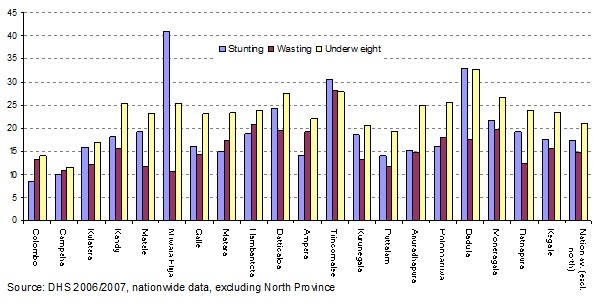
According to the 2006 DHS(Demographic and Health Survey) report, the highest prevalence of underweight in children under five is observed in Badulla district, where it is more than 30 percent. The prevalence of underweight in Kandy, NuwaraEliya, Batticaloe, Trincomalee, Polonnaruwa and Monaragala districts is between 25 and 30 percent.. The lowest prevalence of underweight is observed in Colombo, Gampaha and Kalutara districts.


Wasting Prevalence

The weight-for-height index (wasted) measures body mass in relation to body length and describes current nutritional status. Children whose Z-scores are below minus two standard deviations (-2 SD) from the mean of the reference population are considered thin (wasted) for their height and are acutely malnourished. Wasting represents the failure to receive adequate nutrition in the period immediately preceding the survey and may be the result of inadequate food intake or a recent episode of illness causing loss of weight and the onset of malnutrition.

According to the 2006 DHS report, the highest prevalence of wasting among children under 5 is observed in Trincomalee district, where it is more than 28 percent. The prevalence of wasting in Kandy, Matara, Batticaloe, Ampara, Polonnaruwa, Badulla, Monaragala and Kegalle districts is between 15 percent and 20 percent.


Stunting Prevalence

The height-for-age index is an indicator of linear growth retardation and cumulative growth deficits. Children whose height-for-age Z-score is below minus two standard deviations (-2 SD) from the mean of the reference population are considered short for their age (stunted) and are chronically malnourished. Stunting reflects the failure to receive adequate nutrition over a long period of time and is also affected by recurrent and chronic illness. Height-for-age, therefore, represents the long-term effects of malnutrition in a population and does not vary according to recent dietary intake.

According to the 2006 DHS report, the highest prevalence of stunting among children under five is observed in NuwaraEliya, Trincomalee and Badulla districts, where it is greater than 30 percent.


Prevalence of Anemia in Children

Common causes of anemia include inadequate intake of iron, folate, vitamin B12 or other nutrients. Anemia can also result from thalassemia, sickle cell disease, malaria, and intestinal worm infestation. Anemia may be the underlying cause of maternal mortality, spontaneous abortion, premature birth, and low birth weight.

According to the NFSS 2009 data more than one fourth (25 percent) of Sri Lankan children between the age 6-59 months are anemic. Anemia is highest among children age 6-11 months, and children who live in Jaffna district.

Some of the important measures to reduce anemia includes iron and folic acid supplementation, antimalarial prophylaxis for pregnant women, promotion of the use of insecticide-treated bed-nets and deworming for children.

Over-Nutrition

Over-Nutrition implies overweight and obesity, known as the “Nutrition Transition”. They are measures of excess weight relative to height for children and adults (measured by body mass index (BMI), or weight/height2). This is primarily due to increased intake of fats and processed carbohydrates and reduced physical activity. Overweight and obese individuals have greater risk of developing Non Communicable Disease (NCD): diabetes, high blood pressure, stroke, cardiovascular disease, and some forms of cancer. NCDs, often precipitated by poor nutrition, presently account for 60% of global deaths and 46% of the global burden of diseases (the overall impact of disease and injuries at the individual and societal level). By 2020, NCDs and obesity are predicted to cause 73% of all deaths and 60% of all disease. Today, about 1.2 million Sri Lankan adults are overweight and among schoolchildren 0.4 million are overweight in Sri Lanka.

Maternal Nutrition

Currently 0.1 million pregnant women are underweight in Sri Lanka. Malnourished mothers leads to higher rates of complications and deaths and end up with poor pregnancy outcomes, such as low birth weight, birth defects, bleeding, high-risk deliveries, all of which influence survival and child development. Though the energy and nutrient needs are more during the pregnancy, mothers actually consume less food during pregnancy often out of fear of labour complications resulting from a larger fetus. Low birth weight babies face a higher risk of obesity and or NCDs in adulthood. Today, one fifth of babies are born as low birth weight babies, lead by NuwaraEliya district which indicates that one third of babies born in this district are low birth weight.


Finally, however vast the problem is the conclusion is simple.

We must UNITE for malnutrition through inter-sectoral collaboration under one umbrella developing common action plan for all sectors with TARGETED interventions in order for us to thrive for better nutrition within Sri Lanka.


Written by-

Dr.Renuka Jayatissa (MBBS,MSc,MD)

Nutrition Specialist and Head, Department of Nutrition, MRI