Followers |ලිපි පල කළ සැණින් දැනුවත් වන්න !

Showing posts with label Malnutrition. Show all posts

Friday, October 21, 2011

Manioc can be harmful! | මඤ්ඤොක්කා වැඩිපුර කන්නේ බලාගෙනයි!


Until recently, manioc (cassava) has been in the lime light as a food with anti-cancerous properties due to the availability of ‘vitamin B17’.

We inquired about this from the World Health Organisation (WHO) headquarters, Geneva. The WHO Joint Secretary to JECFA and JMPR replied that the Joint FAO/WHO expert committee on Food Additives (JECFA) had recently assessed the toxic nature of cyanogenic glycosides. They confirmed that ‘vitamin B17’ is not in fact a vitamin.

The following information on manioc is provided for three reasons:

1. Cyanogenic glycoside
Manioc contains a cyanogenic glycoside called linamarin, a compound related to amygdalin. ‘Vitamin B17’ falls under the compound called amygdalin, which occurs naturally in plants. However, amygdalin belongs to the group of compounds known as ‘cyanogenic glycosides’, which contains cyanide (toxic compound which can have a negative effect on the central nervous system) that can be released upon digestion in the human body, which can even be a source of intoxication.

2. High glycemic index (GI)
Studies have shown that manioc has a very high GI of around 94, compared with white bread (reference food). High GI food rapidly raises blood glucose, which leads to you being hungry faster. Comparatively, low GI food releases glucose more slowly and steadily, which is more favourable as you feel full for longer. 

3. Low protein
Manioc has a minimum amount of protein available, so consuming a meal with only manioc can lead to “protein-calorie malnutrition”. This is where inadequate amount of protein in the diet can lead to malnutrition. This form of malnutrition can eventually lead to kwashiorkor and marasmus in children.

However, it is ok to consume manioc as a curry as a part of your main meal on occasion.

Below is the letter sent by WHO for your information:

"The so-called 'vitamin B17' is in fact no vitamin, it is a compound called amygdalin that occurs naturally in certain plants. I understand that this has been promoted as cancer treatment, however this is totally non-scientific and there seems to be no evidence of effectiveness. To the contrary, amygdalin belongs to the group on compounds called 'cyanogenic glycosides' which contain cyanide that can be liberated when digested in the human body, and can even be a source of intoxication.
Cassava also contains a cyanogenic glycoside called linamarin, a compound related to amygdalin.
The Joint FAO/WHO Expert Committee on Food Additives (JECFA) has just recently evaluated the toxicity of cyanogenic glycosides, and the summary report is accessible on the web: http://www.who.int/foodsafety/chem/jecfa/summaries/Summary74.pdf . The full report and detailed monographs are in preparation and will be published by the end of this year."


For the Sinhalese version of this article Click Here | මෙම ලිපියේ සිංහල පරිවර්තනය සඳහා මෙතැනට යන්න.

Image courtesy of http://www.erroluys.com/Kindle/KindleIllustratedGuide.htm

Wednesday, October 12, 2011

ඇමයිලේස් බහුල ආහාර වලින් දරුවන්ට වඩාත් ගුණාත්මක අතිරේක ආහාර.....| Amylase Rich Food (ARF) |

සාමාන්‍යයෙන් ළදරුවනට අතිරේක ආහාර ලබා දීම ආරම්භ කරන විට පළමුව බත් කැද දීමට පුරුදුව ඇත. මෙම කැද බොහෝවිට පිළියෙළ කරුණු ලබන්නේ බත් හෝ වෙනත් ධාන්‍ය වර්ගයක් යොදාගෙනය. නමුත් මෙම ආහාරයේ ශක්ති ජනක අගය අඩු වන අතර දියරමය ස්වභාවය ද වැඩි වේ.එනිසා මෙය ළදරුවාගේ දිනක ශක්ති අවශ්‍යතාව සපුරලිඉමට අපොහොසත් වේ. මෙයට හොදම විසදුම වන්නේ ඇමයිලේස් බහුල ආහාරයක් මෙයට එකතු කිරීමයි.එමගින් ආහාරයේ මුළු පරිමාව අඩු වන අතර එහි ශක්ති ප්‍රමානය ද වැඩි වේ.එනිසා එය ළදරුවාට පහසුවෙන් ආහාරයට ගත හකිවේ. මෙම ඇමයිලේස් බහුල ආහාර ඔබට නිවසේදීම පිළියෙළ කර ගත හැකි වේ.ඒ සදහා පහත ක්‍රමය යොදාගත හැක.

1. මුං , කවුපි , උඳු යන ඕනෑම ධාන්‍ය වර්ගයක් තෝරා ගන්න.
2. එය මුල් අදින තුරු වතුරේ පොඟවා ගන්න;පැය 48 ක් පමණ තැබීම ප්‍රමාණවත් වේ.
3. පසුව එය හිරු එළියේ හෝ උදුනක අඩු උෂ්ණත්වයක් යටතේ වියලා ගන්න.

4.වියලුනු පසුව එය කුඩු කර ගන්න

5.එම කුඩු පියන හොදින් වැසිය හැකි බෝතලයක බහා තබන්න.

6. ළදරුවාට ආහාර පිළියෙළ කරන විට මෙම කුඩු තේ හැදි 1 ක් ඊට එකතු කරන්න
මෙය ඔබට නිවසේදී සාදා ගත හැකි සුළු මුදලක් වැයවන ආහාරයේ ගන ස්වභාවය වැඩි කර එහි ශක්ති ප්‍රමාණය ද වැඩි කරන පෝෂණ අතිරේකයකි. ඔබත් ළදරුවකු සිටින මවක නම් මෙය අත්හදා බලන්න.


For the English version of this article Click Here๧මම ල๢ප๢๧ය๞ ඉංග්රීසි ප໱ව໮තනය සඳහ๟ ๧මත๠නට යන๞න

Thursday, October 6, 2011

Amylase Rich Food (ARF) | බබාට දෙන කෑම වල ගුණය වැඩි කර ගන්න, ගෙදරදීම "ඇමයිලේස්" එකතු කර ගනිමු.

Preparation of ARF in the MRI laboratory

During complementary feeding (after 6 months of age), traditionally; the first food introduced to a child is porridge. This is usually prepared from a cereal or cereal flour such as mung, cowpea or ulundu. These porridges tend to have a high viscosity and a low energy content, which may not meet the daily energy requirements of the child.

The addition of ARF lowers the dietary bulk and increases the energy content, thus making the porridge easier to consume as well as increasing the calorie content per unit volume of food consumed.

Amylase is an enzyme that catalyses the breakdown of starch (carbohydrate) into sugars. 

ARF can be easily produced at inexpensively at home, the preparation method can be seen below:

1. Select whole, unbroken grains (i.e. mung, cowpea, ulundu)

2. Soak the grain in water until sprouting takes place (around 48 hours)

3. Dry in the sun / roast lightly on low flame

4. Powder by hand pounding or in an electric grinder

5. Store in a wide mouthed screw cap bottle

6. Add one teaspoon powder to the cereal during the preparation of feeding

Teaching mothers to prepare inexpensive AFR at the household level; Dr.C.L Piyasena Explaning
Homemade ARF is both easy and inexpensive to help prepare a low-bulk, high energy dense meal for your child.


Source: Gopaldas T, Deshpande S, Chinnamma J. Studies on a wheat-based amylase-rich food. The United Nations University.


For the Sinhalese version of this article Click Here | මෙම ලිපියේ සිංහල පරිවර්තනය සඳහා මෙතැනට යන්න. 

Wednesday, October 5, 2011

3G රේඩියෝ අහමු | Listen to 3G Radio Service

මොකද්ද මේ 3G රේඩියෝව?

මේක අලුත්ම උත්සාහයක්. මෙහිදී අප උත්සාහ කරන්නේ ජනයා අතරටම ගොස් ඔවුන්ගේ පෝෂණ දැනුම උසස් කිරීමටයි.මෙවැනි ක්‍රියාමාර්ග "ප්‍රජාව සවිබල ගැන්වීම/Community Empowerment" ලෙස හඳුන්වනවා. ප්‍රධාන වශයෙන්ම කුඩා දරුවන්ට ආහාර දීමේ පුරුදු නිවැරදි කිරීම මගින් පෝෂණ හා සෞඛ්‍ය තත්වය උසස් කිරීම අප මෙහිදී බලාපොරොත්තු වෙනවා.


වැඩසටහන ක්‍රියාත්මක වන්නේ මෙහෙමයි,

මුලින්ම අප විසින් යම් ග්‍රාමයක් තෝරා ගෙන ඔවුන්ට නිවැරදි ආහාර පුරුදු ගැන පුහුණුවක් දෙනු ලබනවා.ඒ සඳහා පෙර පිහිටුවා ඇති මාධ්‍ය සමාජ උපකාරී වනවා.

ඉන්පසුව ඔවුන් එම දැනුම නාට්‍යානුසාරයෙන් ඉදිරිපත් කරනවා.එම පිටපත් අධ්‍යක්ෂණය ආදී සියල්ලම කරන්නේ ගමෙන්ම සොයාගත් දක්ෂයින් අතින්.මෙමගින් ඔවුන්ගේ කලා කුසලතාවයන්ට වේදිකාවක් විවර වෙනවා. කවි ,සින්දු මෙන්ම රසවත් දෙබස් ඇතුලත්ව කරන මෙම වැඩසටහන සකස් වී ඇත්තේ ආච්චි, දුව හා මිනිපිරිය යන පරම්පරා තුන නියෝජනය වන ආකාරයටයි; එමනිසා 3 Generations යන අර්ථයෙන් මෙයට "3G Radio" කියා නම තබා තිබෙනවා.

ගමේ පොදු ස්ථානයකදී මෙම වැඩසටහන් සජීවීව සිදුකරන අතර සමහර වැවසටහන් පටිගත කර පසුව විකාශය කරනවා; ඒ ගුවන්විදුලි සංස්ථාවේ ප්‍රාදේශීය සේවා ඔස්සේ සවස 4 සිට 5 දක්වා කාලය තුලයි.

මාසයකට පැයේ වැඩසටහන් 5ක් පමණ විකාශය වන අතර එම වෙලාවන් කලින් ගුවන්විදුලියෙන් දැනුම් දෙනවා, මෙම වැඩසටහන් ශ්‍රවණය කිරීමට එම ගම්වල පුල පුලා බලා සිටිනවා, ඒ ඔවුන්ගේ නිර්මාණ රටටම ඇසෙන්න විකාශය වන අයුරු ශ්‍රවණය කිරීමටයි.

අප විසින් සෑම පටිගත කිරීමක් අතරතුරම ,පෙර සතියක පටිගත කල වැඩසටහනක් ගුවන් විදුලිය ඔස්සේ එම ජනතාවට ඇසීමට සලස්වනවා. එමෙන්ම සෑම වැඩසටහනකටම පෙර හා පසු ගැමියන්ගේ දැනුම් මට්ටම මැන බැලීමක්ද සිදු කරනවා.

මෙම සංකල්පය අන්තර්ජාතික තරඟයකට ඉදිරිපත් කර ජයග්‍රහණය කළ වැඩපිළිවෙලක්, දැනට මෙය ඈත පිටිසර ගම් නියම්ගම් රැසක ඉතා ඉහල ජන ප්‍රසාදයක් සහිතව දියත් කිරීමට අපට හැකිවී තිබෙනවා. මෙය  ක්‍රියාත්මක කරන්නේ "3G රේඩියෝ ටීම්" මගින්.

මෙම වැඩසටහන් නුදුරේදීම වැඩසටහන් මාලාවක් ලෙස බ්ලොග් අවකාශයට දායාද කිරීමට අප බලාපොරොත්තු වෙනවා, එමගින් මෙම වැඩසටහන් ගුවන් විදුලි විකාශන කාලය තුල අසා ගැනීමට නොහැකි අයට අසාගැනීමට මෙන්ම අනාගතයෙදීද අසා ගැනීමට සංචය කර තබාගැනීමට හැකිවනු ඇති.ගුවන් විදුලිය ඔස්සේ මේවා සජීවීව ශ්‍රවණය කිරීමට කැමති ඔබ හට , එම ගුවන් කාලයන් හා සංඛ්‍යාත අපි පසුව දැනුම් දෙන්නම්.

පහත දැක්වෙන්නේ පසුගියදා දකුණු පළාතේ බෙංගමුව නම් ග්‍රාමයේදී සිදු කළ වැඩසටහනක්. එම වැඩසටහන කෙරුණු ආකාරය වීඩියෝවේ දැක්වෙන පින්තූර මගින් පෙන්වා තිබෙනවා.


මෙම වැඩසටහනේ පිටපත මෙතැනින් බලා ගන්න

මෙම නැවුම් ව්‍යායාමය ඔබටත් නැවුම් අත්දැකීමක් වනු නියතයි!


ලිව්වේ- වෛද්‍ය වේදිෂ ගන්කන්ද, 
විශේෂ ස්තුතිය - 3G රේඩියෝ කණ්ඩායමේ සමන් කුමාර ප්‍රියදර්ශණ මහතා ඇතුළු සාමාජිකයන්ට හා ගම්වාසීන්ට.

Thursday, September 22, 2011

මඤ්ඤොක්කා වැඩිපුර කන්නේ බලාගෙනයි! | Manioc can be harmful !

Pic source-http://www.learnnc.org/lp/multimedia/6986

මෑත කාලීනව, වැඩිපුර මඤ්ඤොක්කා ආහාරයට ගැනීමේ ප්‍රවණතාවයක් දක්නට ලැබෙනවා. මෙයට එක් හේතුවක් නම් එහි අඩංගු විටමින් "B17" නම් ප්‍රති-පිළිකාකාරක සංයෝගයක් ගැන ඇතිවූ කතාබහයි.


මේ ගැන අප ජිනීවා හි ලෝක සෞඛ්‍ය සංවිධානයෙන් විමසුවා.එහි ආහාර සුරක්ෂිතතාවය(Food safety)අහාර රසකාරක/පරිරක්ෂක(JECFA-Joint FAO/WHO Committee On Food Additives)මෙන්ම රසායනික කෘමිනාශක වලින් ආහාර වලට අති බලපෑම(JMPR -Joint FAO/WHO Meetings on Pesticide Residues)පිළිබඳ ලේකම්වරිය අප වෙත වාර්තා කර සිටියේ මෙවැනි "විටමින් B17" නම් සංයෝගයක් නැති බවත් එය සමහර ශාඛ වල ස්වභාවිකවම හට ගන්න amygdalin නම් සංයෝගයක් බවත්ය, මෙහි කිසිදු විද්‍යාත්මක ව ඔප්පු කළ ප්‍රති-පිළිකාකාරක ගුණයක් නොමැති බවද ඔවුන් වැඩි දුරටත් ප්‍රකාශ කර සිටිනවා.
අප මේ ගැන ඔබ දැනුවත් කිරීමට අදහස් කලේ කරුණු 3ක් නිසයි.

1.
මඤ්ඤොක්කා නිසි ලෙස ආහාරයට නොගැනීමෙන් විෂ සහිත විය හැකියි,එයට හේතුව එහි ඇති amygdalin linamarin වැනි සංයෝග අහාර ජීර්ණ පද්ධතිය තුලදී සයනයිඩ් බවට පෙරලීමට හැකි වීමයි.එනිසා මේවා සයනයිඩ් කාරක සංයෝග (cyanogenic glycosides) ලෙස හඳුන්වනවා.

2.මඤ්ඤොක්කා යනු ඉතාම ඉහල
ග්ලයිසීමික් අගයයක්(Glyceamic Index) සහිත ආහාරයක්. ග්ලයිසීමික් අගය යනු අප සීනි සහිත ආහාරයක් ගත් විට රුධිරයේ සීනි ප්‍රමාණය ඉහල යන වේගයයි. මෙය පාන් වලට සාපේක්ෂව මනින අතර පාන් වල අගය 100ක් වන විට එය මඤ්ඤොක්කා වල 94ක් වනවා(එය දෙල් වල 60ක් ද, රොටී වල65ක්ද පමණ වීමෙන් මෙය කෙතරම් ඉහල අගයක්දැයි ඔබට පෙනෙනවා ඇති).මේනිසා දියවැඩියාව වැනි රෝගයකින් පෙළෙන පුද්ගලයෙකු විශාල ප්‍රමාණවලින් මඤ්ඤොක්කා ආහාරයට ගැනීමෙන් වැලකීම වැදගත්ය.  

3.මඤ්ඤොක්කා යනු ප්‍රොටීන් අවම වන ආහාරයක්, එම නිසා මඤ්ඤොක්කා පමණක් ආහාරයට ගැනීමෙන් ඔබේ කැලරි අවශ්‍යතාවය සපිරුනත්, ප්‍රෝටීන් අවශ්‍යතාවය සැපිරීම සිදු නොවීම නිසා "ප්‍රෝටීන් කැලරි දුශ්පෝෂණය";එනම් මන්දපෝෂණයට ලක් විය හැකියි. මීට දශක කිහිපයකට පෙර ප්‍රෝටීන බහුල ආහාර හිඟ වූ සමයේ බතල,මඤ්ඤොක්කා වැනි ආහාර මත අධික ලෙස යැපීම නිසා ලංකාවේ මැරස්මස්, ක්වෝෂියෝකෝර් වැනි උග්‍ර මන්දපෝෂණ තත්ත්ව
ඉහල ගිය බව අප අත්දැක තිබෙනවා.  


කෙසේ නමුත් මඤ්ඤොක්කා ව්‍යංජනයක් හෝ ප්‍රධාන ආහාරවේල සඳහා අල වර්ගයක් ලෙස ගැනීමේ වරදක් නැත.
ඔබේ දැනගැනීම පිණිස ලෝක සෞඛ්‍ය සංවිධානයෙන් අප වෙත දැන්වූ ලිපියෙන් කොටසක් පහත දැක්වෙනවා.
"the so-called 'vitamin B17' is in fact no vitamin, it is a compound called amygdalin that occurs naturally in certain plants. I understand that this has been promoted as cancer treatment, however this is totally non-scientific and there seems to be no evidence of effectiveness. To the contrary, amygdalin belongs to the group on compounds called 'cyanogenic glycosides' which contain cyanide that can be liberated when digested in the human body, and can even be a source of intoxication.
Cassava also contains a cyanogenic glycoside called linamarin, a compound related to amygdalin.
The Joint FAO/WHO Expert Committee on Food Additives (JECFA) has just recently evaluated the toxicity of cyanogenic glycosides, and the summary report is accessible on the web: http://www.who.int/foodsafety/chem/jecfa/summaries/Summary74.pdf . The full report and detailed monographs are in preparation and will be published by the end of this year."


ලිව්වේ -වෛද්‍ය වේදිෂ ගන්කන්ද
උපදෙස්- වෛද්‍ය රේණුකා ජයතිස්ස
මූලාශ්‍ර - 
http://www.nutritionsociety.org.uk/bjn/091/0971/0910971.pdf
            http://www.who.int/foodsafety/chem/jecfa/summaries/Summary74.pdf


For the English version of this article Click Here | ๧මම ල๢ප๢๧ය๞ ඉංග්රීසි ප໱ව໮තනය සඳහ๟ ๧මත๠නට යන๞න. 

Thursday, June 30, 2011

මම මහතයිද? මම කෙට්ටුයිද? - ශරීර ස්කන්ධ දර්ශකය මනිමු | Know your Body Mass Index |

ඔබ නිතරම ඔබේ සෞඛ්‍ය තත්ත්වය ගැන සැලකිලිමත් වෙනවා නේද? එසේනම් ඔබ අසනීප වූ විට දැනගන්නේ කෙසේද? ශ්වසන මාර්ගයේ අසනීපයක් ඇතිවිත උණ ගන්නවා, සොටු දියර ගලනවා, කැස්ස එනවා. ආහාර මාර්ගයේ නම් බඩ රිදීම, වමනය, පාචනය ආදිය සිදු වෙනවා. මෙවැනි අමාරුකම් නැති විට අපි "හොඳ " සෞඛ්‍ය තත්ත්වයෙන් ඉන්නවා යැයි සිතනවා.

නමුත්, අපට නොපෙනෙන රෝග තත්ත්වයක් අප සතුව තිබිය හැකියි. "දුෂ්පෝෂණය" එවැනි රෝග තත්ත්වයක්. දුෂ්පෝෂණය යන්නට මන්ද පෝෂණය මෙන්ම අධි පෝෂණයද ඇතුලත්.

දුප්පත් පොහොසත් භේදයකින් තොරව ,අපේ වැරදි ආහාර පුරුදු නිසා අප සියල්ලෝම ඉහත සඳහන් කල ආකාර දෙකටම ලක්වීමට පුළුවන්.

මමත් මන්ද පෝෂණයෙන්/ අධි පෝෂණයෙන් පෙලෙනවාද?

මෙය දැන් ඔබට අනිවාර්යයෙන්ම ඇතිවන ප්‍රශ්නයක්. පිලිතුර හරිම සරලයි.ඔබේ ශරීර ස්කන්ධ දර්ශකය(BMI) ගණනය කරන්න.

BMI අගය යනු කුමක්ද?

මෙය ශරීරයේ උසට සරිලන බරක් තිබීම පිලිබඳ මිනුමකි.මෙය බර(kg)/උස(m)^2 යන සමීකරණයෙන් ලබාගත හැක. ලාංකීය වැඩිහිටියකුගේ මෙය 18 kg/m2 හා 23.5 kg/m2 අතර තිබීම අපේක්ෂා කෙරේ.මෙම අගයට වැඩි හෝ අඩු වීම දුශ්පෝෂණ තත්ත්වයකි.

ඔබේ වයසට අනුව නිවැරදි අංකය(A,B,C) වෙත ගමන් කරන්න.

A.ඔබ පාසැල් ශිෂ්‍යයෙකු(වයස අවු.5-18)නම්,

වයස අවුරුදු 5ට වැඩි ඕනෑම වයසක අයෙකුට ,මෙම වගුව ඇසුරෙන් තම BMI අගයත් ,තිබිය යුතු අවම හා උපරිම බරත් දැකගත හැකියි.මෙහිදී ඔබ +2 හා -2 අතර කලාපයේ සිටීනම් එය නිවැරදි BMI අගයක් වෙනවා.

BMI අගය මෙමගින් දැන ගන්න


පිරිමි ළමුන් සඳහා නම්, දැන් එයමෙතැන click කර ලැබෙන ප්‍රස්ථාරයට ඇතුලත් කර ඔබ සිටිනා ශරීර ස්කන්ධ දර්ශක කලාපය හඳුනා ගන්න.

ගැහැනු ළමුන් සඳහා නම්, දැන් එය දැන් එයමෙතැන click කර ලැබෙන ප්‍රස්ථාරයට ඇතුලත් කර ඔබ සිටිනා ශරීර ස්කන්ධ දර්ශක කලාපය හඳුනා ගන්න.


B.ඔබ වැඩිහිටියකු(අවු.18ට වැඩි ) නම්,

වයස අවුරුදු 18ට වැඩි ඕනෑම අයෙකුට පහත මෘදුකාංගයට උස හා බර ලබාදීමෙන් BMI අගය ලබාගෙන එය ප්‍රස්තාර ගත කරගත හැකියි.මෙහිදී ඔබ කහපාට කලාපයේ සිටීනම් එය නිවැරදි BMI අගයක් වෙනවා.


C.වයස අවු. 5ට අඩු දරුවෙක් නම්,

අවුරුදු 5ට අඩු දරුවන් සඳහා පහත දැක්වෙන වගු භාවිතා කර ඔවුන්ගේ දිග(අවුරුදු 2ට අඩු දරුවන් සඳහා දිග භාවිතා වේ) උසට අනුව බර වැටෙන්නේ කුමන වර්ණ තීරුවටදැයි බලා ගන්න. දරුවා මෙහි කොළ හෝ ළා කොළ පාට කලාපයේ සිටිය යුතුයි.


ඔබට ඔබේ පෝෂණ තත්ත්වය පිළිබඳ ගැටළු ඇත්නම්,
පෝෂණ තොරතුරු ඒකකය, වෛද්‍ය පර්යේෂණ ආයතනය, බොරැල්ල වෙත ඒවා යොමු කරන්න.ඒවාට පිළිතුරු ලබා දීමට අප සැම විටම සැදී පැහැදී සිටිනවා.

written by Dr.Wedisha Gankanda


For the English version of this article Click Here | ๧මම ල๢ප๢๧ය๞ ඉංග්රීසි ප໱ව໮තනය සඳහ๟ ๧මත๠නට යන๞න. 

Tuesday, June 28, 2011

Know your Body Mass Index | මම මහතයිද? මම කෙට්ටුයිද? - ශරීර ස්කන්ධ දර්ශකය මනිමු

Body Mass Index(BMI) is the single best predictor of your malnutrition state.

Remember , both "Over" nutrition and "Under" nutrition is considered "Malnutrition" and both cause trouble.

Since the height of the adults wont change, you can easily keep an eye on your BMI value by regularly measuring your weight using a correct scale.


use this software to calculate your BMI, and plot it so that you can easily see to which category you fall in to. The formula for BMI is Weight(Kg)/Height(m)^2.

Try to be in the "Normal" (Yellow) Zone, if you are deviated try to adjust your exercise + diet to achieve that zone; more regular weight measurement is also essential. Consult your family doctor if you need any help, he'll direct you to a Nutritionist for counseling.

For any nutritional/dietary information feel free to contact us on -

Nutrition information center,
Medical research institute ,
Borella , Colombo 08
0112693532-4 ext 825
0112695999

PS- Please consider that in these calculations desirable BMI levels has been taken as 18.5 to 25 kg/m2 ; for the asian populations it's recommended to take the upper limit as 23.5 kg/m2

written by Dr.Wedisha Gankanda


For the Sinhalese version of this article Click Here | ๧මම ල๢ප๢๧ය๞ ස๢๜හල ප໱ව໮තනය සඳහ๟ ๧මත๠නට යන๞න. 

Tuesday, May 24, 2011

Current Nutritional Status of Chilren in Sri Lanka |ශ්‍රී ලංකාවේ ළමා පෝෂණ තත්ත්වය පිලිබඳ විපරමක්!


Overall, the nutritional status of children under 5 years in Sri Lanka has not improved in the past ten years. In 2009, 19.2 percent of children were stunted, 21.6 percent underweight and 11.7 percent were wasted nationwide, compared with 18.4 percent stunting, 22.8 percent underweight and 15.5 percent wasting in year 2000.

Malnutrition remains a serious problem for Sri Lankan children and Sri Lanka generally. The 2009 NFSS(National Food Security Survey) indicates that only 36.4 percent of households in the poorest quintile reported having had adequate food supply for every day in the past 12 months compared to 91.4 percent of the richest quintile.

In Sri Lanka, even the children of the relatively rich suffer from high rates of malnutrition which goes up to 11.9%. This supports the perception that while inadequate food access (and by extension low incomes and low and variable productivity of food crops for household consumption) is critical, poor infant and child feeding practices (e.g. too early or too late introduction of complementary feeding and inappropriate complementary food) and poor public health also play a significant role.

Vitamin A deficiency is linked to access to vitamin-rich food for children, poor breastfeeding practices, and high prevalence of childhood diseases such as acute respiratory infections, diarrhea and measles. According to the 2006 national survey, 29 percent of children under 5 were Vitamin A deficient and 74.6 percent were given vitamin A megadose. Children of mothers with at least primary schooling are at least 16 percent more likely to receive vitamin A than those without schooling.

Sri Lanka has also reported high levels of anaemia – 25.2 percent among children, 22.2 percent among women, 16.7 percent among pregnant women, (NFSS 2009).

As with other health indicators, child malnutrition sharply declines with increases in the level of the mother’s education, in particular between primary and secondary level schooling. Thus it is clear that educating women is a critical factor in reducing malnutrition over time. Education is important and links need to be sought with the education sector for school-based interventions (e.g. school feeding programs or micro-nutrient initiatives). Effective nutrition programs are likely to have a significant impact in estate areas given the higher prevalence of malnutrition amongst the poorer quintiles.

Underweight Prevalence


Weight-for-age (underweight) is a composite index of height-for-age (stunted) and weight- for-height (wasted). It takes into account both acute and chronic malnutrition. Children whose weight-for-age is below minus two standard deviations (-2 SD) from the mean of the reference population are classified as underweight.

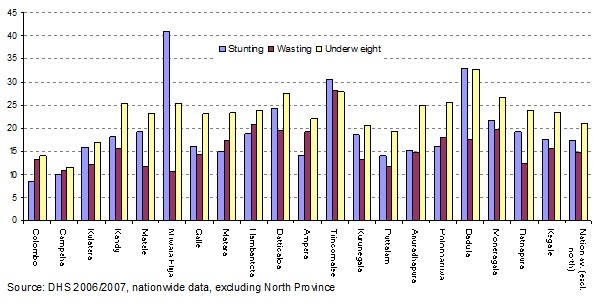
According to the 2006 DHS(Demographic and Health Survey) report, the highest prevalence of underweight in children under five is observed in Badulla district, where it is more than 30 percent. The prevalence of underweight in Kandy, NuwaraEliya, Batticaloe, Trincomalee, Polonnaruwa and Monaragala districts is between 25 and 30 percent.. The lowest prevalence of underweight is observed in Colombo, Gampaha and Kalutara districts.


Wasting Prevalence

The weight-for-height index (wasted) measures body mass in relation to body length and describes current nutritional status. Children whose Z-scores are below minus two standard deviations (-2 SD) from the mean of the reference population are considered thin (wasted) for their height and are acutely malnourished. Wasting represents the failure to receive adequate nutrition in the period immediately preceding the survey and may be the result of inadequate food intake or a recent episode of illness causing loss of weight and the onset of malnutrition.

According to the 2006 DHS report, the highest prevalence of wasting among children under 5 is observed in Trincomalee district, where it is more than 28 percent. The prevalence of wasting in Kandy, Matara, Batticaloe, Ampara, Polonnaruwa, Badulla, Monaragala and Kegalle districts is between 15 percent and 20 percent.


Stunting Prevalence

The height-for-age index is an indicator of linear growth retardation and cumulative growth deficits. Children whose height-for-age Z-score is below minus two standard deviations (-2 SD) from the mean of the reference population are considered short for their age (stunted) and are chronically malnourished. Stunting reflects the failure to receive adequate nutrition over a long period of time and is also affected by recurrent and chronic illness. Height-for-age, therefore, represents the long-term effects of malnutrition in a population and does not vary according to recent dietary intake.

According to the 2006 DHS report, the highest prevalence of stunting among children under five is observed in NuwaraEliya, Trincomalee and Badulla districts, where it is greater than 30 percent.


Prevalence of Anemia in Children

Common causes of anemia include inadequate intake of iron, folate, vitamin B12 or other nutrients. Anemia can also result from thalassemia, sickle cell disease, malaria, and intestinal worm infestation. Anemia may be the underlying cause of maternal mortality, spontaneous abortion, premature birth, and low birth weight.

According to the NFSS 2009 data more than one fourth (25 percent) of Sri Lankan children between the age 6-59 months are anemic. Anemia is highest among children age 6-11 months, and children who live in Jaffna district.

Some of the important measures to reduce anemia includes iron and folic acid supplementation, antimalarial prophylaxis for pregnant women, promotion of the use of insecticide-treated bed-nets and deworming for children.

Over-Nutrition

Over-Nutrition implies overweight and obesity, known as the “Nutrition Transition”. They are measures of excess weight relative to height for children and adults (measured by body mass index (BMI), or weight/height2). This is primarily due to increased intake of fats and processed carbohydrates and reduced physical activity. Overweight and obese individuals have greater risk of developing Non Communicable Disease (NCD): diabetes, high blood pressure, stroke, cardiovascular disease, and some forms of cancer. NCDs, often precipitated by poor nutrition, presently account for 60% of global deaths and 46% of the global burden of diseases (the overall impact of disease and injuries at the individual and societal level). By 2020, NCDs and obesity are predicted to cause 73% of all deaths and 60% of all disease. Today, about 1.2 million Sri Lankan adults are overweight and among schoolchildren 0.4 million are overweight in Sri Lanka.

Maternal Nutrition

Currently 0.1 million pregnant women are underweight in Sri Lanka. Malnourished mothers leads to higher rates of complications and deaths and end up with poor pregnancy outcomes, such as low birth weight, birth defects, bleeding, high-risk deliveries, all of which influence survival and child development. Though the energy and nutrient needs are more during the pregnancy, mothers actually consume less food during pregnancy often out of fear of labour complications resulting from a larger fetus. Low birth weight babies face a higher risk of obesity and or NCDs in adulthood. Today, one fifth of babies are born as low birth weight babies, lead by NuwaraEliya district which indicates that one third of babies born in this district are low birth weight.


Finally, however vast the problem is the conclusion is simple.

We must UNITE for malnutrition through inter-sectoral collaboration under one umbrella developing common action plan for all sectors with TARGETED interventions in order for us to thrive for better nutrition within Sri Lanka.


Written by-

Dr.Renuka Jayatissa (MBBS,MSc,MD)

Nutrition Specialist and Head, Department of Nutrition, MRI